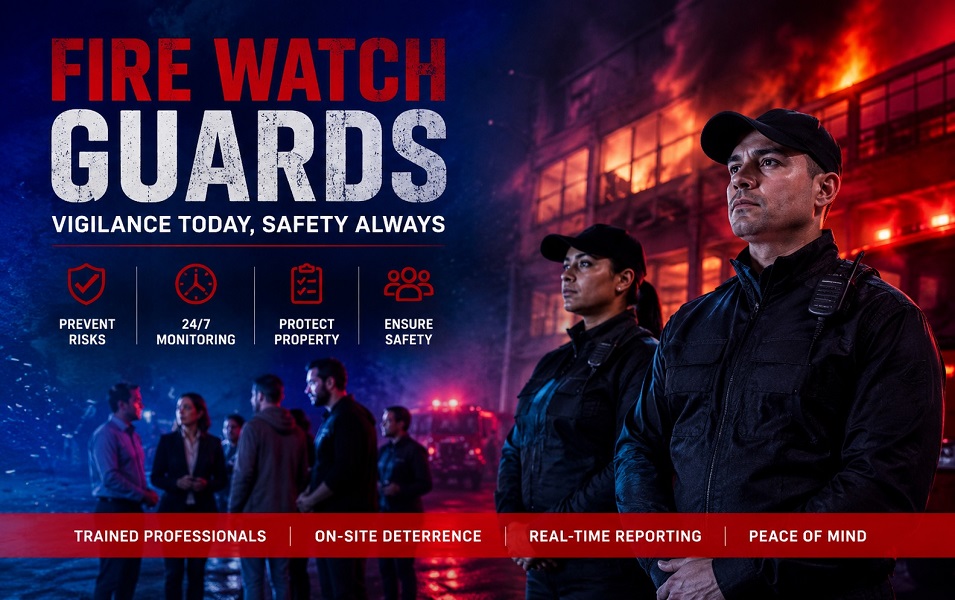
When a sprinkler system fails, a welding torch sparks in the wrong direction, or a fire alarm goes offline during a high-occupancy event, the gap between safety and catastrophe narrows fast. That gap is where fire watch guards step in — not as a formality, but as the last credible line of defense between a building full of people and an uncontrolled blaze. These professionals exist precisely because technology fails, regulations demand accountability, and fires don’t wait for systems to reboot.
The stakes have never been higher. Across the United States, thousands of commercial properties, construction sites, and industrial facilities deploy fire watch services every day — many of them legally required doing so. And the outcomes, time and again, validate why.
When Systems Fail, Humans Must Step Up
Modern fire protection infrastructure is sophisticated, but it is not infallible. Sprinkler systems go offline for maintenance. Fire alarms malfunction mid-renovation. High-rise construction zones operate for months without permanent detection systems in place. In each of these scenarios, the law is clear — and so is common sense.
The National Fire Protection Association (NFPA) and local fire codes across the country mandate that when fire suppression systems are inoperative for more than four hours, fire watch personnel must be deployed immediately. California’s Fire Code is explicit about this requirement in public occupancy cases. Failure to comply invites fines, forced closures, and — far worse — the legal and moral weight of preventable casualties.
This isn’t bureaucratic red tape. It’s a protocol born from decades of hard lessons.
What a Fire Watch Guard Actually Does
The role is frequently misunderstood. A fire watch guard is not a security officer standing by a door. They are trained, certified safety professionals who conduct systematic patrols — typically every 15 to 30 minutes — across an entire facility. That includes stairwells, mechanical rooms, rooftop access points, storage areas, and active hot work zones.
Their responsibilities unfold across several critical layers. They inspect fire extinguishers for accessibility and expiration. They verify emergency exits remain unobstructed. They monitor welding and cutting operations for stray sparks. They check for flammable material storage violations and overloaded electrical circuits. And they maintain direct communication lines to fire departments and site supervisors at all times.
When a threat surfaces — a smoldering pile of debris, a blocked exit, smoke drifting from an unseen corner — the guard doesn’t wait. They escalate immediately, enact the emergency plan, contact first responders, and begin coordinating the evacuation. That sequence, executed in the right order and at the right speed, is what separates a near-miss from a headline.
The Human Advantage Over Automated Detection
There’s a persistent assumption in facility management that automation has made human oversight redundant. That assumption is wrong, and the fire safety industry knows it.
Automated systems detect fires after ignition thresholds are reached. A trained fire watch professional identifies conditions that lead to ignition — long before any sensor triggers. They catch the improperly stored solvent near an active heat source. They notice the welding crew who left combustible debris behind. They spot the fire door propped open during a late-night shift.
Technology measures outcomes. Humans read context. That distinction is not philosophical — it is operationally decisive.
Digital reporting tools are increasingly being layered into fire watch operations, adding time-stamped patrol logs, photographic documentation, and real-time incident alerts. This hybrid model — trained personnel supported by smart reporting infrastructure — creates a defensible paper trail that holds up in insurance claims, fire marshal reviews, and litigation.
Why Construction Sites Are Ground Zero for Fire Risk
Of all the environments where fire watch services prove their worth, active construction sites carry the highest baseline risk. Open electrical systems, exposed flammable materials, hot work happening across multiple floors simultaneously, and the absence of permanent fire detection equipment create a volatile combination.
In these settings, fire watch guards serve as the only consistent safety net. They monitor hot work zones for post-weld embers — a common ignition source that can smolder for hours before catching. They verify that fire suppression equipment is functional and accessible in zones where permanent systems haven’t yet been installed. And they ensure that subcontractors follow site-specific safety protocols, regardless of the speed pressure they’re under.
General contractors, project managers, and insurance underwriters have all come to recognize the presence of documented fire watch coverage as a risk management benchmark. It’s not just about compliance — it’s about demonstrating that every reasonable precaution was taken.
Legal Liability, Insurance, and the Cost of Not Knowing
Here’s the part that facility managers and property owners often underestimate: the financial and legal exposure of skipping fire watch coverage can dwarf the cost of the service itself.
When fire-related incidents occur on unprotected properties — particularly when system outages were known and unaddressed — the liability exposure is severe. Courts and insurers examine whether the property operator demonstrated due diligence. Documented fire watch logs, signed patrol reports, and a clear chain of communication are evidence of that diligence. Their absence is evidence of negligence.
Beyond liability, the regulatory consequences are immediate. Fire marshals who conduct post-incident investigations or routine inspections can issue closure orders and steep fines for non-compliance with fire watch requirements. In competitive commercial real estate and hospitality markets, even a temporary shutdown carries reputational damage that compounds quickly.
The Moments That Matter Most
Consider what happens in the critical window after a sprinkler system goes offline unexpectedly at a mid-rise hotel. Guests are still in their rooms. Maintenance is working through the night. No automated backup kicks in for that section of the building. This exact scenario plays out across American cities more often than most people realize — and the difference between a resolved incident and a tragedy often comes down to whether a qualified professional was walking that hallway.
Fire watch guards are trained to perform under pressure, to communicate clearly in high-stress situations, and to guide building occupants through evacuations with calm authority. Their training includes working alongside first responders — not just calling 911 and stepping back, but actively supporting the coordination of emergency response. That integration of human skill with institutional emergency systems is what accelerates safe outcomes.
A Profession Built on Accountability
Every patrol log filed. Every hazard reported. Every near-miss documented and escalated. These are not administrative details — they are the anatomy of accountability.
Fire watch guards operate in an environment where the margin for error is zero. Their documentation becomes the institutional memory of a facility’s safety posture, reviewed by insurance carriers, audited by fire marshals, and relied upon in legal proceedings. Providers like Just Fire Watch have built their service model around this standard, delivering certified, compliant, and continuously trained personnel who understand that their presence is never symbolic.
The proof isn’t theoretical. It’s written in the patrol logs, the near-miss reports, and the incidents that never made the news — because someone was watching.